Cryptocurrencies allow funds to be transferred quickly across borders, but criminals also exploit the irreversible nature of these transactions. Fraudulent investments, suspicious platforms, impersonation of advisers, and requests to deposit cash through a Bitcoin ATM are just some of the risks.
A cryptocurrency scam can look highly professional. Scammers create websites that resemble legitimate exchanges, publish ads featuring well-known people, and contact potential victims by phone, messaging apps, or social media.
This guide explains how cryptocurrency scams work, which warning signs to look out for, and how to reduce the risk of losing your funds.
What Are Cryptocurrency Investment Scams?
An investment scam involves persuading someone to transfer money or cryptocurrency on the promise of making a profit. The scammer may pose as an adviser, broker, cryptocurrency exchange employee, fund recovery specialist, or representative of a well-known institution.
The victim is offered an investment that is supposedly safe, easy, and exceptionally profitable. The offer often includes claims of:
- guaranteed returns,
- no risk,
- access to confidential information,
- an automated trading system,
- a limited-time offer,
- the opportunity to grow your capital quickly.
No cryptocurrency investment can guarantee a profit. FINMA notes that unauthorized financial service providers and investment scammers often use similar methods. Always check the company and the people offering the investment carefully before transferring any funds.
What Do Cryptocurrency Scams Look Like in Practice?
Initial contact usually takes place through an online advertisement, a social media message, a dating app, email, text message, or phone call.
An advertisement may suggest that a well-known entrepreneur, investor, or TV presenter is promoting a platform for making money with Bitcoin. Shortly after the form is submitted, an “investment adviser” makes contact.
At first, the scammer may ask for a small deposit. The user is then given access to a professional-looking dashboard showing a growing balance and apparent profits. However, the figures displayed on the website may not reflect any real transactions.
When the user tries to withdraw the money, further fees appear:
- tax on profits,
- withdrawal fee,
- verification fee,
- an account unlocking fee,
- security deposit,
- an anti-money laundering fee.
After the payment is made, the scammers demand more money or stop responding altogether.
Why Are Cryptocurrency Scams So Common?
One reason is the nature of blockchain transactions. Once a cryptocurrency transfer is confirmed, it generally cannot be reversed in the same way as a traditional bank transfer.
Scammers also use:
- the international nature of the market,
- rapid transfers of funds,
- interest in Bitcoin and new projects,
- the limited knowledge of novice users,
- difficulty in identifying a legitimate company,
- the ability to create anonymous profiles and websites,
- pressure created by the fear of missing out on an investment opportunity.
The Swiss National Cyber Security Centre warns about fake investment advertisements, phishing attacks targeting cryptocurrency holders, and companies that promise to recover money lost in an earlier scam.
How Do Scammers Use Psychology to Manipulate Investors?
Many scams succeed not because of advanced technology, but because scammers know how to manipulate people’s emotions.
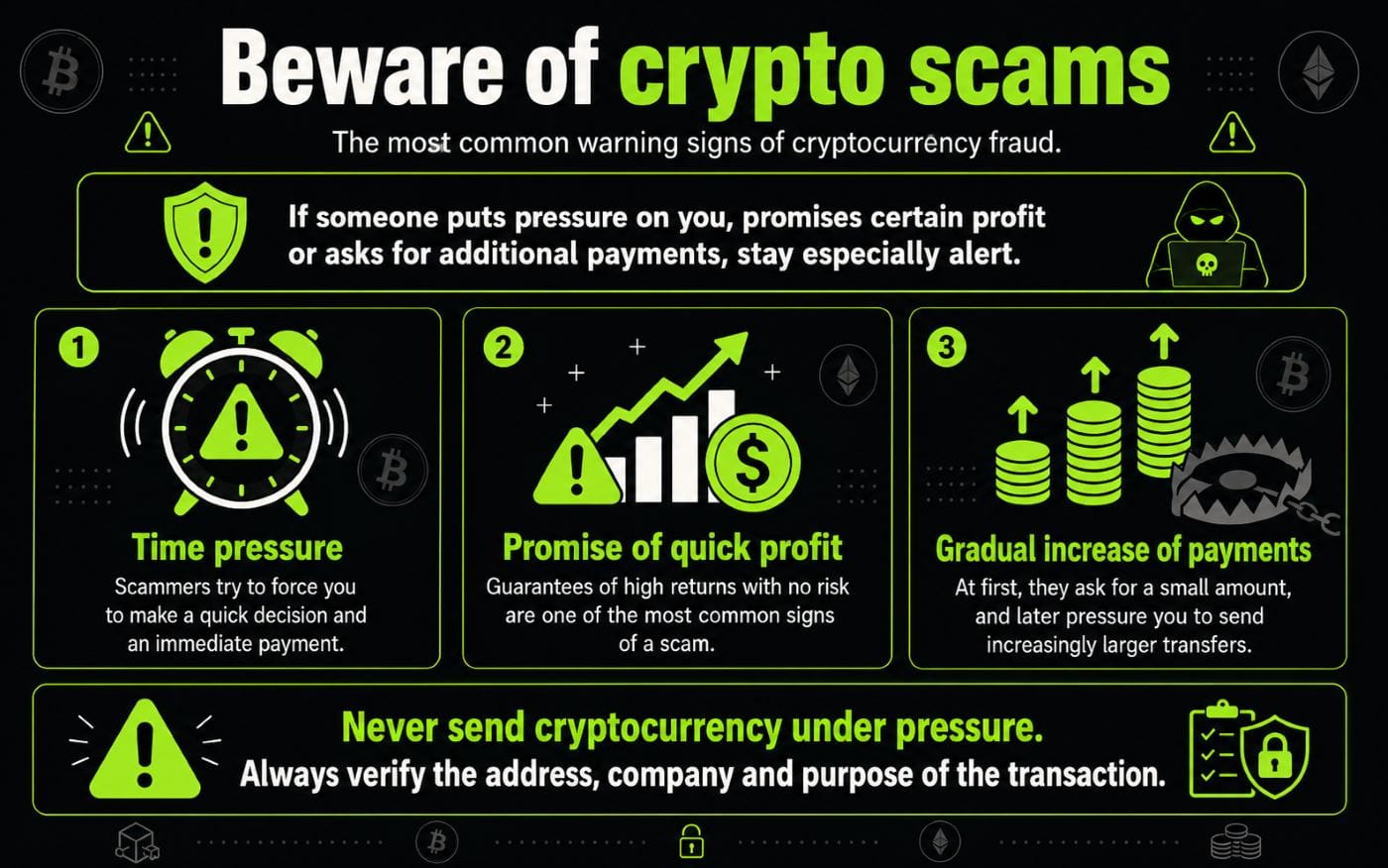
Time Pressure
Scammers claim that the offer will expire within a few hours or that the price of a particular cryptocurrency is about to rise sharply. Their goal is to leave you too little time to verify the information.
The Promise of Quick Profits
The victim sees supposed results from other investors, fake comments, or fabricated withdrawal confirmations. This is intended to create the impression that making money is easy and almost guaranteed.
Establishing Authority
A criminal may impersonate a bank employee, police officer, government official, cryptocurrency exchange representative, well-known investor, or technical support agent.
Gradually Increasing Deposits
The first deposit is small. Once the user sees a fictitious profit, the scammer persuades them to deposit a larger amount.
Instilling Fear
The victim is told that their account is at risk, that someone is trying to steal their savings, or that they have been linked to a crime. They are then instructed to send money to a supposedly secure wallet.
Isolating the Victim
Scammers may tell you not to contact your family, bank, Bitcoin ATM staff, or the police. They may claim that the transaction is confidential or that a third party could block it.
The Most Common Types of Cryptocurrency Scams
Free Rewards and Fake Airdrops
The user is told that they can claim free tokens by connecting their wallet to a website or signing a message.
A fake website may obtain permission to transfer tokens out of the wallet. Another variation asks the user to send a small amount to “activate” the reward.
A legitimate airdrop should never require your recovery phrase or private key.
Ransomware
Ransomware is malware that either blocks access to a device or encrypts the files on it. The cybercriminals then demand a ransom, often in cryptocurrency.
Paying a ransom does not guarantee that your data will be recovered. The most important safeguards are keeping your system up to date, being cautious when opening attachments, and storing regular backups separately from your main device.
Blackmail
The victim receives a message in which the sender claims to have compromising recordings, data, or a history of online activity. In exchange for deleting the material, the sender demands payment in Bitcoin.
Messages like these are often sent in bulk. They may include an old password from a previous data breach to make the threat seem more credible.
Do not pay or respond. Change your passwords, enable two-factor authentication, and report the blackmail attempt to the relevant authorities.
Rug Pull Scams
A rug pull occurs when a project’s creators promote a new token, raise funds from users, and then withdraw the liquidity or abandon the project.
Be cautious of projects that:
- do not provide information about the team,
- promise unrealistic returns,
- have not undergone a code audit,
- have unclear documentation,
- base their promotion exclusively on influencers,
- hold a large proportion of the tokens in only a few wallets,
- prevent the token from being sold freely.
Phishing Scams
Phishing involves impersonating a legitimate platform, wallet provider, bank, or government agency. The user receives a link to a website designed to look like the genuine service.
A fake website may try to steal:
- username and password,
- authentication code,
- recovery phrase,
- private key,
- card details,
- access to the wallet.
Before logging in, check the full website address. It's safer to use a bookmark in your browser than a link sent in a message.
Fake Giveaways on Social Media
Scammers create profiles that resemble the accounts of well-known entrepreneurs, cryptocurrency exchanges, or crypto projects. They then announce a cryptocurrency giveaway.
A typical message promises to return twice as many tokens if the user first sends a specified amount to the stated address.
A legitimate company will never require you to send cryptocurrency in advance to claim a reward.
Ponzi Schemes
A Ponzi scheme pays earlier participants using money deposited by new users. It may appear profitable for a while because the first withdrawals are actually processed.
Problems begin when the number of new deposits falls. The organizers then restrict withdrawals, introduce additional fees, or disappear with the money.
A red flag is a consistent, high, and guaranteed return that is independent of market conditions.
Fake cryptocurrency exchanges
A fake cryptocurrency exchange may look like a legitimate investment platform. It may display charts, transaction history, balances, and customer support, but all of this information can be controlled by scammers.
Before depositing any money, check:
- domain history,
- company information,
- terms and conditions and contact details,
- the ability to make a small withdrawal,
- warnings issued by regulators,
- account security methods,
- independent reviews from multiple sources.
The presence of a Swiss address or a Swiss flag does not mean that a company genuinely operates in Switzerland. FINMA notes that some suspicious providers merely claim to have a Swiss office.
Flash Loan Attacks
Flash loans are an advanced tool used in decentralized finance. They allow users to borrow funds without collateral, provided that the loan is repaid within the same blockchain transaction.
Attackers can exploit vulnerabilities in a smart contract, manipulate a token’s price or the oracle mechanism, and drain funds from the protocol.
This is primarily a threat to DeFi applications and their liquidity providers. Before using a protocol, review its audits, project history, and risk management rules.
Scams Involving Bitcoin ATMs
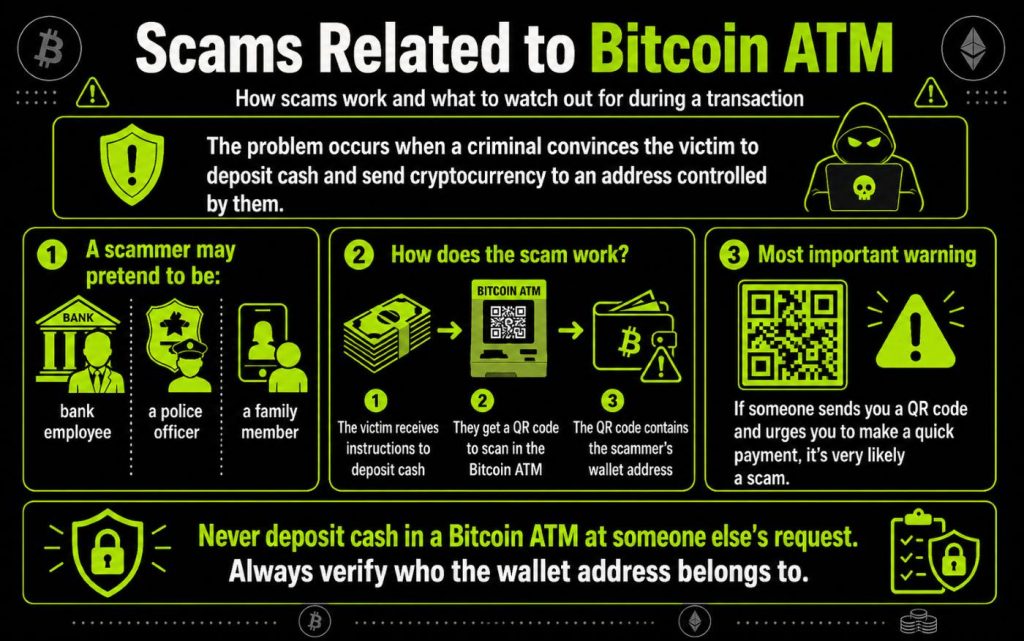
A Bitcoin ATM is a legitimate device for buying or selling cryptocurrency. The machine itself is not the source of the scam. The problem arises when a criminal persuades a victim to deposit cash and send cryptocurrency to an address controlled by the criminal.
A scammer may pose as:
- a bank employee,
- police officer,
- tax official,
- a technical support representative,
- a family member,
- a cryptocurrency exchange representative,
- an investment adviser.
The victim receives a QR code and is instructed to scan it at a Bitcoin ATM. The code contains the scammer’s wallet address. After the cash is deposited, the cryptocurrency is sent directly to that address.
The FBI and the U.S. Federal Trade Commission warn about scammers who use Bitcoin ATMs and QR codes to steal funds quickly. A common tactic is to pressure the victim into acting immediately and keep them on the phone throughout the transaction.
The Most Important Safety Rule
Do not use a Bitcoin ATM on the instructions of a stranger who contacts you by phone or online.
A bank, the police, a government agency, technical support, or a Bitcoin ATM operator will never ask you to send money to a “secure wallet” in order to:
- secure an account,
- cancel a suspicious transaction,
- pay a fine or tax,
- unlock a computer,
- protect savings,
- identity verification,
- avoid criminal liability.
In a legitimate transaction, you should scan only the address of your own wallet or the address of a recipient you know and have independently verified.
An Example of How Cryptocurrency Scammers Operate
A user sees a social media advertisement for a platform that supposedly invests in Bitcoin. The advertisement uses the logo of a well-known media outlet and a photo of a public figure.
After the person provides a phone number, an “investment adviser” contacts them. The adviser sounds professional and helps them create an account. They initially suggest making a small deposit.
After a few days, the balance shown on the platform indicates a significant profit. The adviser claims that this is the best time to increase the investment and suggests depositing a larger amount by bank transfer, card, or Bitcoin ATM.
When the user tries to withdraw the money, they are told that they must first pay a tax. After the tax is paid, another fee appears for unlocking the account.
At some point, communication stops. The victim is then contacted by another company that promises to recover the funds in exchange for an upfront fee. This is another stage of the same or a similar scam.
The Swiss NCSC warns that scammers offering to recover lost funds often target people who have already fallen victim to a fraudulent investment.
How can you spot a cryptocurrency scam?
Be particularly cautious if an offer includes one or more of the following:
- a guaranteed or exceptionally high return,
- pressure to make an immediate decision,
- contact from an unknown number,
- a request to install remote access software,
- instructions to buy cryptocurrency through a Bitcoin ATM,
- a QR code sent by a stranger,
- a request to provide a recovery phrase,
- a requirement to pay a fee before profits can be withdrawn,
- instructions not to contact your bank or family,
- a promise to recover money lost in a previous scam,
- no option to withdraw funds independently,
- unclear company details.
The higher the promised return, the more suspicious you should be about the level of risk. The Swiss NCSC recommends resisting pressure from salespeople and checking suspicious platforms against FINMA’s warning list, among other sources.
How can you protect yourself from cryptocurrency scams?
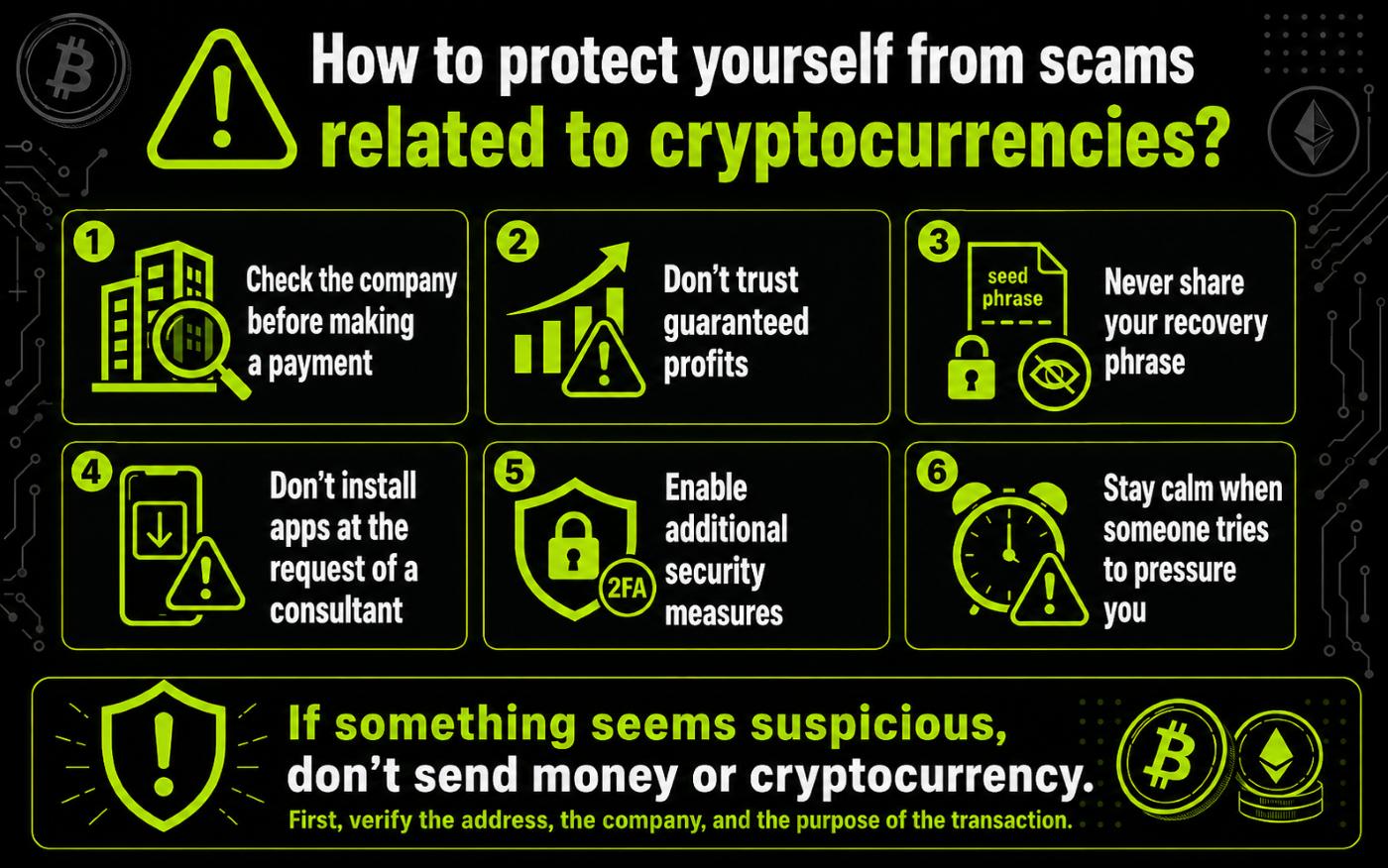
Check the Company Before Depositing Money
Verify the company name, address, management, terms and conditions, and regulatory information. Check FINMA’s warning list and search for any notices the regulator has published about the company.
A company’s absence from the warning list does not automatically prove that it is trustworthy. The list may not include every active scam.
Never Trust Guaranteed Returns
Every investment involves risk. No one can guarantee a specific rate of return on Bitcoin, Ethereum, or other cryptocurrencies.
Never disclose your recovery phrase
A recovery phrase provides full access to a wallet. Never enter it on a website or share it with technical support staff.
A legitimate wallet provider or cryptocurrency exchange will never need your recovery phrase to resolve a problem.
Do Not Install Apps at an Adviser’s Request
Remote access software allows another person to control your computer or phone. A scammer can use it to access your bank account, cryptocurrency exchange account, or wallet.
Enable additional security measures
Use:
- unique passwords,
- password manager,
- two-factor authentication,
- blocked withdrawals,
- allowlists of trusted addresses,
- login notifications,
- up-to-date software.
Do Not Act Under Pressure
Hang up and contact the institution yourself using the number listed on its official website. Do not use the number provided by the caller.
Do not scan unknown QR codes in Bitcoin ATM
A QR code may contain a scammer’s wallet address. Before confirming the transaction, check that the address belongs to you or to a recipient you know.
What should you do if you discover a cryptocurrency scam?
If you suspect that fraud has occurred:
- Cut off all contact with the scammer immediately.
- Do not send any more money, even if the scammer promises that you will then be able to withdraw your funds.
- Save all messages, phone numbers, email addresses, and screenshots.
- Record the recipient’s wallet address and the transaction ID (TXID).
- Make a note of the date, time, amount, type of cryptocurrency, and the network used.
- If the transaction was made at a Bitcoin ATM, record the location of the machine and keep the receipt.
- Contact the cryptocurrency exchange, wallet provider, or Bitcoin ATM operator.
- Report the incident to your local police.
- Report a suspicious website or message to the Swiss NCSC.
- If the case involves a suspicious financial services provider, submit the information to FINMA.
- Change your passwords and disable remote access to your devices.
- Move any remaining cryptocurrency to a new wallet if your recovery phrase has been disclosed.
Do not trust anyone who contacts you after a scam and promises to recover your funds in exchange for another fee. This may be a recovery scam.
Is it possible to recover cryptocurrencies sent to a scammer?
Recovering cryptocurrency can be difficult because a confirmed blockchain transaction cannot simply be canceled. However, the incident should still be reported.
Wallet addresses and fund movements are visible on public blockchains. Law enforcement agencies, cryptocurrency exchanges, and specialist companies can analyze the flow of funds. If the funds reach a platform that verifies its users, the address may, in certain circumstances, be linked to a specific account.
Reporting the incident quickly increases the chance that relevant information can be preserved. Keep the TXID, recipient’s wallet address, and the complete communication history.
Summary
A cryptocurrency scam may begin with an attractive advertisement, a supposed call from your bank, a message from an alleged adviser, or a request for help from someone you know. Scammers most often exploit pressure, fear, and the promise of high returns.
The most important rule is to verify every transaction yourself. Never disclose your recovery phrase, install remote access software, or send cryptocurrency to an address provided by an unknown adviser.
A Bitcoin ATM should be used only for a transaction that you have chosen and verified yourself. If someone on the phone instructs you to deposit cash, sends you a QR code, and claims that this will protect your money, end the call and do not complete the transaction.
This article is for educational purposes only and does not constitute investment or legal advice.
Frequently Asked Questions
The most common warning signs are guaranteed high returns, pressure to deposit money quickly, unclear company details, and problems withdrawing funds. Requests to provide a recovery phrase, install remote access software, or send cryptocurrency to an address supplied by an adviser are also suspicious.
No. The police, a bank, a government agency, or a Bitcoin ATM operator will never ask you to deposit cash into the machine and send cryptocurrency to a “secure wallet.” Such instructions are one of the most common signs of a scam.
Yes. A QR code may contain a scammer’s wallet address. Before making a transaction, make sure the address belongs to you or to a recipient you know and have independently verified.
A confirmed blockchain transaction usually cannot be reversed. However, if you suspect fraud, contact the Bitcoin ATM operator as soon as possible, keep the transaction receipt, and report the incident to the police.
Immediately end all contact, do not send any more funds, and preserve all evidence. Keep the wallet address, transaction ID (TXID), messages, phone numbers, screenshots, and payment receipts.
A guarantee of high or consistent returns is a serious warning sign. The cryptocurrency market is volatile, and no reputable company can guarantee a specific return without risk.
Check the company details, terms and conditions, address, domain history, independent reviews, and whether a small withdrawal is possible. In Switzerland, you should also check FINMA’s warning list.
Yes. Scammers can freely alter the balance and results displayed in the user dashboard. A visible profit does not mean that the funds are actually held on an exchange or have been invested.
Fraud should be reported to the local police and the Swiss National Cyber Security Centre. If the case involves a suspicious financial services company, the information can also be submitted to FINMA.