Blockchain has become one of the most important concepts in the world of cryptocurrencies. Bitcoin, Ethereum, and many other digital-asset networks are built on blockchain technology. But blockchain has a much broader range of uses: it can record information, verify ownership, process payments, and automatically execute predefined operations.
Although blockchain can be very complex from a technical standpoint, its basic principle can be explained relatively simply. Instead of storing all information in a single central database managed by a specific company or institution, data can be recorded in successive blocks and made available to multiple participants on the same network.
How exactly does this mechanism work? Why is it difficult to change information once it has been recorded? And what do cryptography, nodes, and consensus mechanisms have to do with this?
What Is Blockchain?
Blockchain, which literally means a chain of blocks, is a type of digital ledger used to record information in a structured sequence.
Data is grouped into blocks. Once a block is created and validated by the network, it is added to the chain of previously recorded blocks. Over time, this creates an ever-growing history of recorded operations.
You can compare this to a book in which pages are added one after another. Each new page is linked to the previous one, making it possible to verify the order in which events were recorded.
A key difference is that, in many blockchains, a copy of such a ledger is not stored on just one server. It can be stored on multiple computers participating in the network.
Blockchain vs. a Traditional Database
The easiest way to understand the unique characteristics of blockchain is to compare it to a traditional database.
In a traditional system, information is typically managed by a single administrator, such as a bank, company, government agency, or platform operator. That entity sets the rules for accessing the data and can modify it.
In a blockchain, however, the ledger can be shared by many independent participants, and new information is added in accordance with the rules that apply across the entire network. This limits the ability to unilaterally alter the recorded history.
However, this does not mean that blockchain is always the better solution. Traditional databases are often simpler, faster, cheaper to maintain, and easier to manage. Blockchain works best when several independent parties need a shared ledger and do not want to hand over full control of it to a single entity.
How is a new entry created on the blockchain?
The exact process depends on the specific network, but the general procedure is similar.
Consider a user who wants to send cryptocurrency to another address.
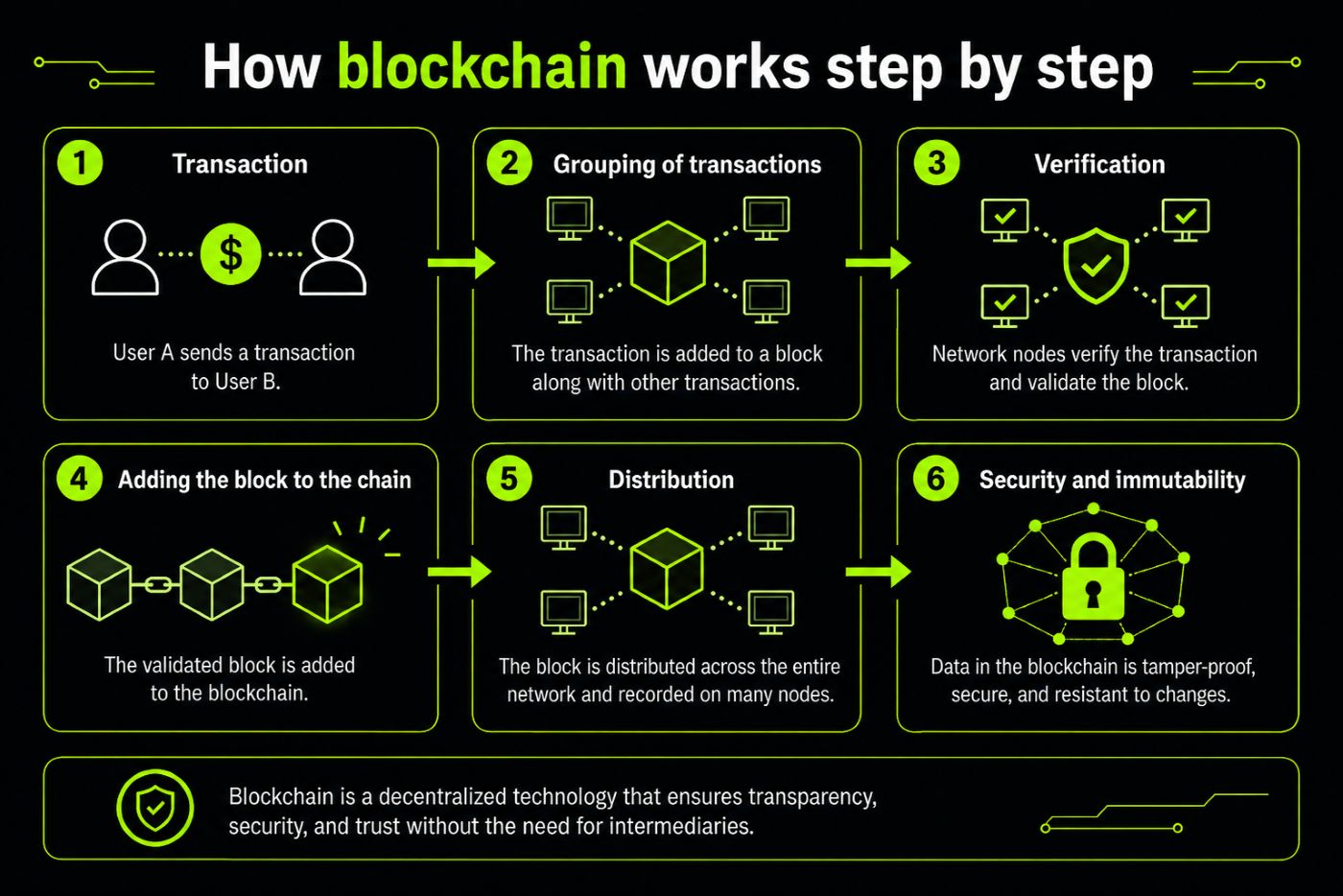
The user first prepares the transaction and authorizes it using their wallet. The transaction is then sent to the network.
The process may look like this:
- The user initiates the operation
- The transaction is sent to the blockchain network
- Network participants verify that the transaction complies with the applicable rules
- Valid transactions are grouped together
- A new block of data is created
- The block is added to the existing chain
- The current state of the ledger is shared with network participants
This means the system does not have to rely on a single central database as the sole source of information about its current state.
What's in a Block?
A block can be defined as an ordered set of data stored in accordance with the rules of a specific blockchain.
In a cryptocurrency network, a block may contain information about completed transactions as well as technical data needed for the system to operate.
Individual blockchains can vary significantly in terms of how blocks are created, their size, and the type of information they store.
What matters most, however, is how they are linked together.
Linking Consecutive Blocks
A new block contains information that links it to the previous block. As a result, the blocks form a chronological chain.
If someone tried to change the data in one of the older blocks, its connection to the rest of the blockchain would also change.
This is why tampering with historical records on a well-secured, large-scale blockchain is extremely difficult.
What is a hash?
One of the most important elements of blockchain technology is a hash, also known as a cryptographic hash.
It is a string of characters generated from specific data. You can think of it as a digital fingerprint of that information.
If even a small portion of the data changes, a different hash will be generated. This makes it possible to detect attempts to modify the stored content.
However, a hash is not the same as encryption.
Encryption is primarily used to hide information from people who do not have the appropriate key. A cryptographic hash, on the other hand, is used to verify data integrity.
Why are nodes important for blockchain?
Blockchain would not function without devices communicating with one another over the same network. These devices are called nodes.
Nodes can:
- relay information about new transactions
- verify their validity
- store blockchain data
- share information with other participants
Not all nodes have to perform exactly the same role. Some store the entire blockchain history, while others work with only a subset of the data.
Distributing information across multiple devices can make the system more resilient to failures. A problem with one computer does not have to mean losing the entire history if other participants also hold copies.
What is decentralization?
In a traditional system, there is usually one administrator or entity responsible for the database.
A decentralized blockchain reduces reliance on a single point of control. Copies of the ledger can be stored by many independent participants, while the rules for updating it are enforced by the network as a whole.
Decentralization can increase:
- resilience
- the ability to independently verify data
- resistance to unilateral manipulation
- independence from a single operator
However, this does not mean that every blockchain is equally decentralized.
The level of decentralization depends, among other things, on the number of network participants, the method used to validate transactions, and how control over the system is distributed.
How does blockchain determine which data is correct?
If a network has many independent participants, it needs a way to determine which version of the data should be considered valid.
That is what the consensus mechanism is for.
It can be described as a set of rules that allow participants to reach consensus on the current state of the blockchain.
Among the best-known solutions are:
Proof of Work
A mechanism that relies on computational work performed by miners. It is used by Bitcoin, among other networks.
Proof of Stake
A model in which participating in the validation process requires holding and locking a specified amount of the relevant assets.
Private Network Mechanisms
In closed blockchains, only specific, pre-approved participants may be allowed to validate data.
Consensus mechanisms vary in speed, cost, energy consumption, and degree of decentralization.
Why is blockchain the foundation of cryptocurrencies?
For cryptocurrencies, the blockchain acts as a ledger that records the current state of digital assets and the history of completed transactions.
This allows the network to verify, among other things, that a user has the funds they want to spend and is not trying to spend the same assets more than once.
It’s worth keeping in mind that a cryptocurrency isn’t stored in a wallet in the same way that a photo or document is stored in a phone’s memory.
The blockchain contains information that shows which assets are associated with individual addresses.
Access to them is controlled by cryptographic keys.
A public address can be used to receive funds.
A private key is used to authorize transactions and should be known only to its owner.
Public, private, and consortium blockchains
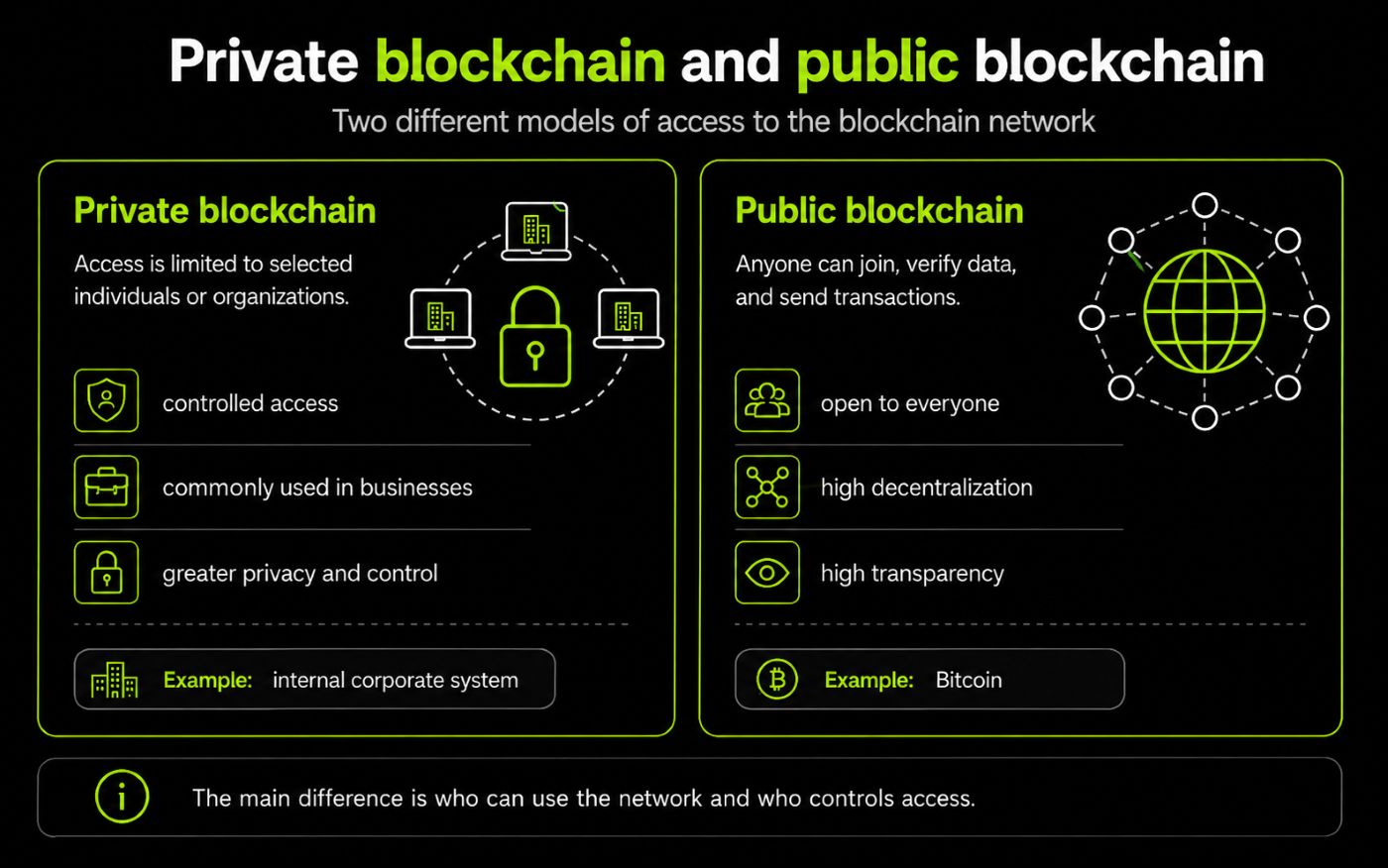
Not all networks operate according to the same rules. One of the most significant differences is how users access the system.
Public blockchain
A public network is open to a wide range of users. Depending on its design, users can view the transaction history, use applications, or run their own node.
Examples of public blockchains include Bitcoin and Ethereum.
Key characteristics include transparency and reduced control by any single entity.
Private blockchain
On a private network, access can be controlled by a company or a specific organization.
Not every user needs to be able to view all data or approve new transactions.
This approach can be useful when a shared ledger is needed but access permissions still have to be controlled.
Consortium blockchain
A middle-ground approach is a blockchain managed jointly by several entities.
Instead of giving a single organization full control, participating companies or institutions can share responsibility for operating the system.
Why is it difficult to change past data?
Blockchain is often described as a technology that provides data immutability. In practice, it is more accurate to speak of very high resistance to later modifications.
There are several factors involved:
- cryptographic links between blocks
- storing information on multiple devices
- consensus mechanisms
- validation of new transactions
- digital signatures
In public, sufficiently distributed networks, tampering with older records becomes increasingly difficult as new blocks are added.
However, this does not mean that it is absolutely immutable in every possible situation. A blockchain may be subject to protocol updates, reorganizations, or network forks.
Is blockchain completely secure?
The way data is stored and linked can provide a high level of security, but blockchain does not eliminate every risk.
Problems can arise, for example, in:
- applications built on blockchain
- cryptocurrency wallets
- smart contracts
- how private keys are stored
Security also depends on the design of a particular network and the number of independent participants responsible for its operation.
Therefore, the term “blockchain-based” does not by itself mean that an application or service is completely immune to errors.
What are smart contracts?
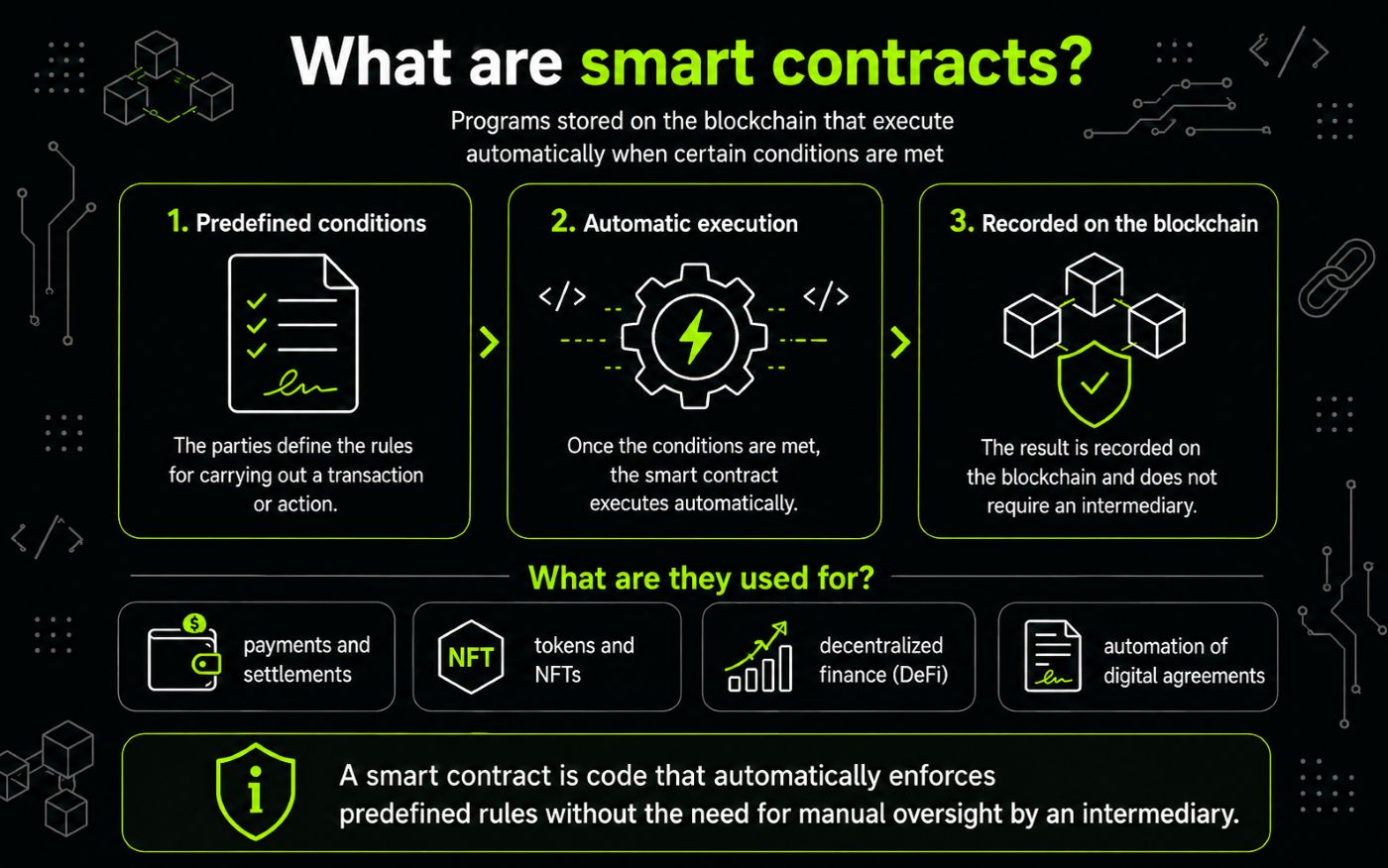
A smart contract is a program that runs on a blockchain.
It can automatically execute specific instructions once predefined conditions are met.
For example, a smart contract can:
- transfer digital assets
- exchange tokens
- distribute funds among several addresses
- handle specific aspects of a loan
- record the voting results
- manage digital ownership
The name can be somewhat misleading, because a smart contract does not have to be a contract in the legal sense. In practice, it is primarily a computer program that runs according to predefined rules.
Automation is a major advantage, but an error in the code can have serious consequences. That is why more complex solutions require thorough testing.
Where is blockchain used outside of cryptocurrencies?
Bitcoin brought blockchain technology into mainstream awareness, but digital money is far from its only use case.
Supply Chains
A shared ledger can be used to record successive stages of production and transport. This makes it easier to verify a product’s history and origin later.
Verification of Ownership
Information about rights related to digital or physical assets can be recorded on the blockchain.
Documents and Certificates
A hash of a document can be stored on the blockchain and later used to verify its authenticity without publishing the entire document.
Decentralized Finance
DeFi applications use smart contracts to perform operations such as exchanging digital assets, lending, and calculating interest.
Voting and Governance
Blockchain can be used to record votes and the results of decisions made by members of specific organizations.
Transfer of Digital Assets
Some networks allow users in different parts of the world to transfer assets to one another. The cost and processing time, however, depend on the specific blockchain.
Is using blockchain anonymous?
A public blockchain does not necessarily mean anonymity.
On many networks, anyone can view the transaction history associated with a given address. The address itself usually does not directly contain the owner’s name, but in some circumstances it can be linked to a specific person using additional information.
Therefore, in the case of many public blockchains, a more precise term is pseudonymityrather than full anonymity.
The Key Advantages of Blockchain
Depending on how the network is designed, blockchain technology can offer benefits such as:
- reducing dependence on a central administrator
- the ability to independently verify transaction history
- data transparency on public networks
- resilience to the failure of a single server
- process automation through smart contracts
- sharing the ledger among independent participants
- the ability to access the network globally
However, not all of these advantages are present to the same extent in every blockchain.
Is blockchain always the best solution?
No.
If the system is operated by a single trusted organization that simply needs an efficient and easy-to-manage database, using blockchain may not offer significant benefits.
Blockchain technology is particularly useful when participants need a shared source of data, want to verify the transaction history independently, and do not want to give a single administrator full control over the ledger.
Before using blockchain, it is therefore worth asking what problem it is actually intended to solve.
Summary
Blockchain is a technology that enables the creation of a shared ledger consisting of interconnected blocks. Its operation relies, among other things, on cryptography, a network of nodes, and consensus mechanisms that allow participants to determine the correct state of the data.
Blockchain underpins many cryptocurrencies, but it can also be used for smart contracts, payment systems, digital ownership, documents, supply chains, and decentralized finance applications.
Blockchain’s greatest value is not simply that it stores data. The key is that it can create a ledger whose history can be independently verified by many participants and cannot easily be altered by a single administrator.
At the same time, blockchain is not an ideal solution for every system. It does not eliminate all risks, does not guarantee complete anonymity, and will not always be better than a traditional database. Its use makes the most sense in situations where decentralized control, transparency, and the ability to verify history truly matter.
Frequently Asked Questions
A blockchain is a digital ledger in which information is recorded in successive blocks linked together in an ordered chain. In many networks, copies of the ledger are stored by multiple independent participants.
A user initiates a transaction and sends it to the network. The transaction is then validated according to the rules of that blockchain. Validated transactions can be included in a new block, which is then added to the existing chain.
Blocks are linked using cryptographic mechanisms. Changing information in an older block would affect its link to the rest of the chain. In large, decentralized networks, consensus mechanisms and multiple copies of the ledger provide additional protection.
A traditional database is typically managed by a single administrator. In a blockchain, the ledger can be shared among many participants, and the ability to add and validate information depends on the rules governing the network.
Cryptocurrencies use blockchain to record transactions and the current state of digital assets. This allows the network to verify whether a user has sufficient funds and whether a transaction complies with its rules.
No. There are public, private, and consortium blockchains. The level of decentralization depends on factors such as the number of participants, how transactions are validated, and who controls the network.
Not always. On many public blockchains, the transaction history associated with a specific address is publicly visible. The address itself does not necessarily contain any personal information, which is why such networks are more often described as pseudonymous rather than fully anonymous.
Blockchain can be used, among other things, to support smart contracts, track supply chains, confirm ownership, verify documents and certificates, enable decentralized finance, and record votes.