Cryptocurrencies are no longer a concept known only to programmers and tech enthusiasts. Today, Bitcoin, Ethereum, and stablecoins are used for investing, storing value, sending money, and making online payments.
In Switzerland, interest in digital assets is particularly evident. Cryptocurrencies can be purchased through online platforms, certain financial institutions, and brick-and-mortar Bitcoin ATMs. However, beginners should first understand what cryptocurrencies are, how blockchain works, and how to securely store the funds they purchase.
What is cryptocurrency?
A cryptocurrency is a digital asset that can be transferred between users via a computer network. It does not exist in the form of banknotes or coins. Information about its ownership and transfers is recorded electronically.
Most cryptocurrencies use cryptography, which is a method of securing data through mathematics. Thanks to cryptography, the network can verify that a transaction was initiated by the person holding the corresponding private key, without having to disclose that key to other participants.
In the case of decentralized cryptocurrencies, such as Bitcoin, transactions are not approved by a single bank or payment processor. Instead, they are approved by a distributed network of devices operating according to established rules.
How do cryptocurrencies differ from Swiss francs?
The Swiss franc is the official currency of Switzerland. Its issuance and monetary policy are managed by the Swiss National Bank.
Bitcoin and other cryptocurrencies are not issued by the Swiss central bank. They operate based on code, the rules of a specific network, and the activities of its users.
The most important differences concern:
- the method of issuing new units,
- control over the system,
- price volatility,
- the ability to reverse a transaction,
- rules for storing funds,
- responsibility for access to the wallet.
Money in a traditional bank account is held by the bank. With a self-custody cryptocurrency wallet, the user is responsible for securing the keys needed to access the funds.
What is blockchain?
A blockchain is a distributed ledger of transactions stored on multiple computers. The data is grouped into blocks that form an ordered chain.
The key features of blockchain are:
- the lack of a single central database,
- the ability to check transactions,
- a high level of security,
- It is difficult to modify the stored information.
Blockchain is not used exclusively by cryptocurrencies. It can also be used to support digital contracts, payments, asset tokenization, and product tracking.
Bitcoin, Altcoins, and Tokens – Key Differences
Not all cryptocurrencies work the same way. Individual projects may have different use cases, issuance rules, and levels of decentralization.
Bitcoin
Bitcoin was created as an electronic system for transferring value without a central intermediary. Its maximum supply is capped at 21 million BTC.
Bitcoin is often viewed as a digital investment asset, but it can also be transferred between wallets and purchased with cash at select Bitcoin ATMs in Switzerland.
Altcoins
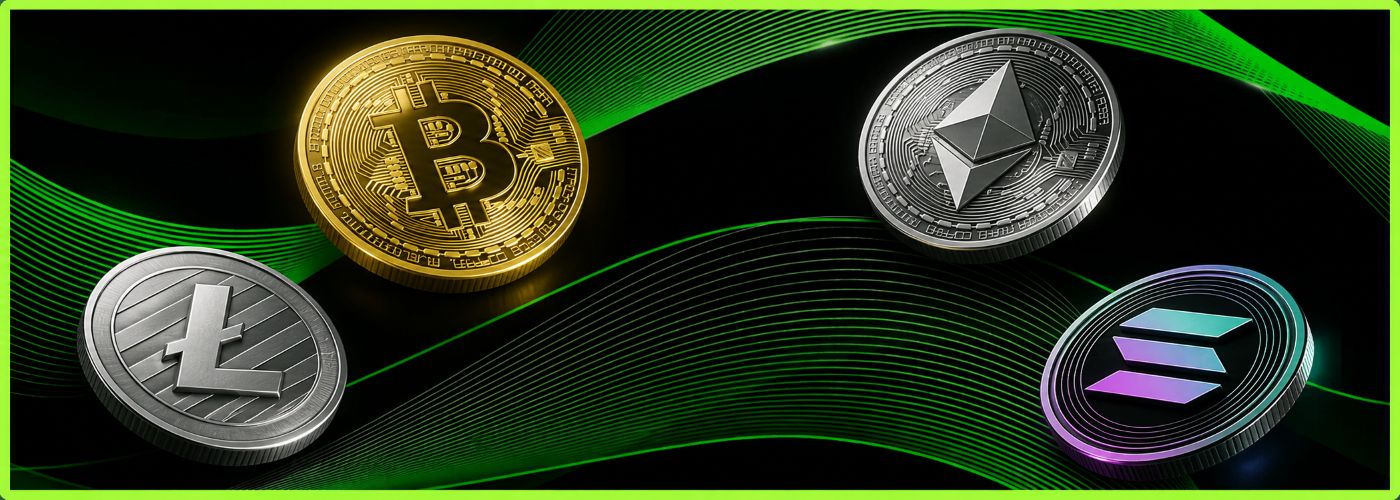
Altcoins are generally defined as cryptocurrencies other than Bitcoin. This group includes, among others, Ethereum, Litecoin, Solana, and Tron.
Some altcoins are primarily used for making payments, while others enable the deployment of applications, smart contracts, or tokens.
Tokens
A token can operate on a blockchain created by another project. For example, many digital assets operate on the Ethereum, Tron, Polygon, or BNB Smart Chain networks.
When sending tokens, pay special attention to the selected network. Sending funds via the wrong blockchain may result in their loss.
What is a stablecoin?
A stablecoin is a digital asset designed so that its price remains pegged to the value of another asset. Most often, the U.S. dollar serves as the benchmark.
Popular stablecoins include:
- Tether, or USDT,
- USD Coin, or USDC.
Their purpose is to reduce the volatility typical of Bitcoin and many altcoins. Stablecoins are used, among other things, for transferring value, settlements, cryptocurrency trading, and temporary storage of funds.
However, being pegged to the dollar does not mean there is absolutely no risk. The security of a stablecoin depends, among other things, on its collateral model, issuer, liquidity, regulation, and the network it uses.
What is a cryptocurrency wallet used for?
A cryptocurrency wallet allows you to receive, store, and send digital assets. It can take the form of a mobile app, a computer program, a web wallet, or a hardware device.
Each wallet uses a public address and a private key.
You can safely share your wallet address with others. Your private key and recovery phrase must remain confidential, as they grant access to your funds.
How do I buy cryptocurrencies in Switzerland?
The Bitcoin ATM at Badenerstrasse 230 also allows users to sell cryptocurrencies.
There are several ways to buy cryptocurrencies:
- on an online marketplace,
- through the selected financial app,
- for cash at a Bitcoin ATM.
To make a purchase at a Bitcoin ATM, you need to have a wallet with a QR code ready. On the device's screen, select the cryptocurrency, scan the wallet address, deposit cash, and confirm the transaction.
Before making a purchase, it's a good idea to check the exchange rate, the commission, the supported network, and the wallet address.
Is it difficult to use a Bitcoin ATM?
Buying cryptocurrency at a kiosk can be easy even for a beginner, provided they have set up their wallet in advance.
A standard transaction includes:
- selection of purchase options,
- specifying a cryptocurrency,
- scan the wallet's QR code,
- entering or confirming the amount,
- cash deposit,
- reviewing the summary,
- approval of the operation,
- Waiting for the funds to be sent.
Before confirming, check the exchange rate, commission, network fee, and wallet address. Transactions recorded on the blockchain usually cannot be canceled.
Are cryptocurrencies safe?
Blockchain technology provides a high level of transaction security, but it does not eliminate all risks.
The most common causes of financial loss include:
- disclosure of the recovery phrase,
- sending funds to the wrong address,
- selecting the wrong network,
- using a fake website or app,
- sending cryptocurrency to a scammer.
Cryptocurrency transactions usually cannot be reversed. Therefore, you should carefully check all the details before confirming the transaction.
How can I get started safely?
A beginner should start with a small amount. This allows them to learn how the portfolio works and how transactions are conducted without taking on a lot of risk.
Key safety rules:
- Use a trusted wallet,
- Write down your recovery phrase somewhere other than your phone,
- Never share your private key,
- Check the address and network,
- Don't trust offers that guarantee quick profits,
- Don't invest more than you can afford to lose.
Summary
Cryptocurrencies are digital assets that operate on blockchain networks. They enable the transfer of value without a traditional intermediary, but require responsible storage and protection of access data.
In Switzerland, you can buy cryptocurrencies online or with cash at a Bitcoin ATM. Before making your first transaction, it’s a good idea to set up a secure wallet, check the fees, and start with a small amount.
Frequently Asked Questions
A cryptocurrency is a digital asset that can be stored and transferred over the internet. Transactions are secured using cryptography and are typically recorded on a blockchain.
Cryptocurrencies are transferred directly between wallet addresses. The network verifies the transaction and then records it on the blockchain.
Blockchain is a distributed ledger that contains a history of transactions. Data is recorded in successive blocks and stored on multiple computers operating within the network.
The most well-known cryptocurrency is Bitcoin. Other popular assets include Ethereum, Tether, USD Coin, Litecoin, Tron, Solana, and Binance Coin.
Yes. The cryptocurrency wallet generates an address to which the purchased funds will be sent. When using a Bitcoin ATM, a mobile wallet with a QR code is the most convenient option.
Cryptocurrencies can be purchased on online exchanges, through select financial apps, and with cash at Bitcoin ATMs. Available assets, currencies, and limits may vary by provider.
Yes, provided you use your own wallet and carefully verify the details before confirming the transaction. You should never scan a QR code sent by a stranger or share your recovery phrase.
Confirmed blockchain transactions generally cannot be reversed. Before sending funds, be sure to check the wallet address, the selected network, and the amount.
Cryptocurrencies can generate a profit, but their prices are highly volatile. You should not invest more than you can afford to lose.
You should use a trusted wallet and protect your private key and recovery phrase. It’s a good idea to store larger amounts in a hardware wallet that operates offline.