Bitcoin is a digital value transfer system that operates without a single central operator. It allows users to send funds directly between addresses, without the need for each transaction to be approved by a bank, card issuer, or other financial institution.
The unit used on the network is BTC, commonly called Bitcoin. It does not exist as physical banknotes or coins. Information about balances and transactions is recorded digitally and verified by computers participating in the network.
Bitcoin is the oldest and best-known cryptocurrency, but it is not synonymous with the entire crypto market. Ethereum, stablecoins and other digital assets can operate according to very different rules. A broader overview is available in the guide What Are Cryptocurrencies and How Do They Work?.
What is Bitcoin?
The term Bitcoin can refer to several closely related things:
- the Bitcoin network, the computers that communicate with one another and verify transactions
- the Bitcoin protocol, the set of rules that defines how the system works
- BTC, the digital unit transferred between users
Bitcoin is not a single application, company, or online bank. It has no headquarters, owner, or board of directors that decides on users’ balances. Individuals and companies can create wallets, exchanges, and other services that use Bitcoin, but they do not own the network itself.
From a user's perspective, Bitcoin can work much like digital cash. Funds can be received at a Bitcoin address and then sent to another user. Unlike a traditional bank transfer, the transaction does not need to pass through a centralized banking system.
Bitcoin, BTC and satoshi: what do these terms mean?
In practice, the terms "Bitcoin" and "BTC" are often used interchangeably, but they do not mean exactly the same thing.
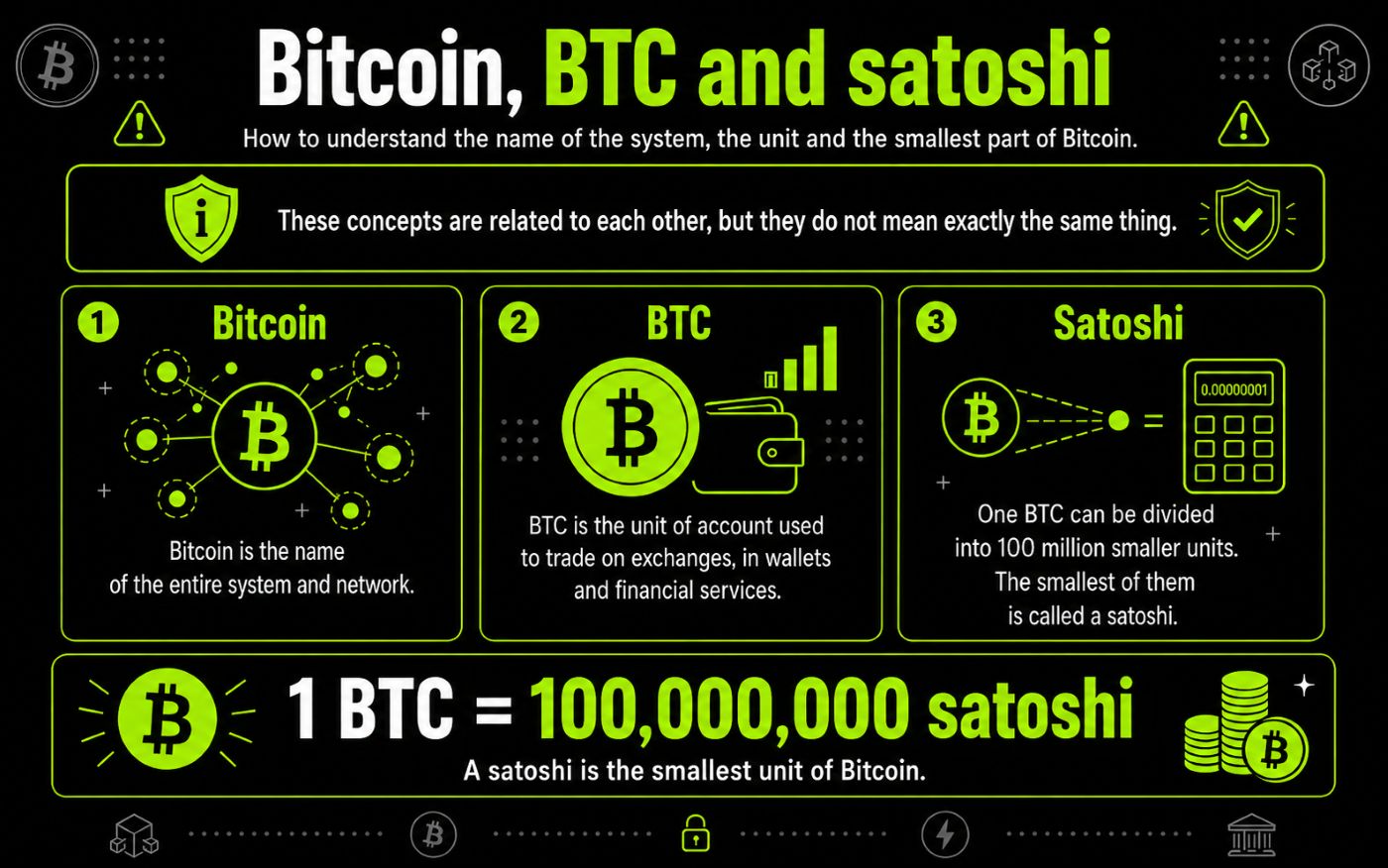
Bitcoin is the name of the entire system and network.
BTC is the symbol for the unit used on exchanges, in wallets and by financial services.
One BTC can be divided into 100 million smaller units. The smallest unit is called a satoshi:
1 BTC = 100,000,000 satoshis
This means you don't have to buy or transfer a whole Bitcoin. For example, you can own 0.01 BTC, 0.001 BTC, or an even smaller fraction. This divisibility allows you to use the network regardless of the current price of a single BTC.
Why was Bitcoin created?
In traditional electronic payments, there is usually a trusted intermediary between the sender and the recipient. This could be a bank, a card issuer, a payment app, or another institution that maintains a central registry.
Among other things, the intermediary checks whether the user has sufficient funds and whether they are trying to spend the same money more than once. In a digital system without a central administrator, solving this problem is much harder because data can be copied easily.
Bitcoin was designed to address the problem of double-spending digital units. Instead of entrusting control to a single institution, the system uses:
- cryptographic signatures
- public transaction history
- independent verification by network participants
- common rules that define which transactions are valid
This allows two parties to transfer value over the internet without relying on a single central ledger maintained by an intermediary. This was the objective described in the original Bitcoin paper, which presented it as a peer-to-peer electronic cash system.
Who created Bitcoin?
Bitcoin was introduced by a person or group using the pseudonym Satoshi Nakamoto.
In 2008, a paper titled "Bitcoin: A Peer-to-Peer Electronic Cash System" was published. It described a way to send payments directly between users and prevent the same units from being spent twice.
The Bitcoin network went live in 2009. The identity of Satoshi Nakamoto has not been definitively confirmed.
Bitcoin is not managed by its creator. The software is open source and developed by independent programmers. Proposed changes do not automatically take effect across the entire network; they must be voluntarily adopted by its participants.
How does Bitcoin work in simple terms?
The detailed technical rules are complex, but the basic transaction can be described in a few steps.
1. The user prepares the transaction
The sender specifies the amount and the address to which they want to send BTC. They do this using a wallet that supports the Bitcoin network.
A wallet does not store physical coins. It manages the information needed to prove that the user is entitled to spend specific funds.
2. The transaction is signed
The wallet uses a private key to create a digital signature. The signature serves as proof that the transaction was authorized by the person who controls the relevant funds.
The private key itself is not sent to the recipient or published on the network.
3. The transaction is broadcast to the network
A signed transaction is relayed between nodes—that is, computers running the Bitcoin software.
Each node can independently check, among other things:
- whether the signature is valid
- whether the specified funds exist
- whether they have already been spent
- whether the transaction follows the network rules
An invalid transaction is rejected.
4. The transaction is recorded
Valid transactions are grouped together and added to the shared transaction history. Creating new blocks is part of the Bitcoin mining process.
Once a transaction is recorded in a block, it receives its first confirmation. Each subsequent block increases the number of confirmations and makes it more difficult to alter the previous record.
5. The recipient can use the funds
The recipient's wallet reads data from the network and displays the amount received. The recipient can then create a new transaction and send the BTC onward.
A separate article explains in more detail what blockchain is and how it works.
What does Bitcoin's decentralization mean?
Decentralization means that Bitcoin is not operated by a single central computer, bank or government authority.
The tasks required to keep the network running are distributed among different participants:
- users create and receive transactions
- nodes verify that transactions follow the rules
- miners help create new blocks
- developers prepare and review proposed changes
- node operators decide which version of the software to run
Decentralization does not mean a lack of rules. Bitcoin works precisely because participants follow specific rules and reject data that does not comply with them.
No single developer, miner or wallet operator can independently increase their balance or change the maximum supply for the entire network. Any attempt to introduce incompatible rules would be rejected by nodes that continue to follow the existing rules.
Changes to Bitcoin are possible, but they require broad adoption by users and organizations across the ecosystem. This means the system does not depend on decisions made by a single administrator.
Why is the supply of Bitcoin limited?
The network's current rules limit the maximum supply to approximately 21 million BTC.
New bitcoins enter circulation according to a schedule built into the protocol. The BTC reward for creating new blocks is periodically cut in half. This event is known as the halving.
Limited supply means that new bitcoins cannot be created at will in response to a decision by a single institution. Nodes verify whether the number of new units complies with the rules. A block containing an excessively high reward would be rejected by them.
However, this does not mean that the price of Bitcoin must rise. Limited availability is just one of many factors affecting its value. If demand falls, the price may drop even if the maximum supply remains unchanged.
Where does Bitcoin's value come from?
Bitcoin's price is not set by a central bank or a single operator. It emerges in the market from transactions between buyers and sellers.
Factors that can affect the value of BTC include:
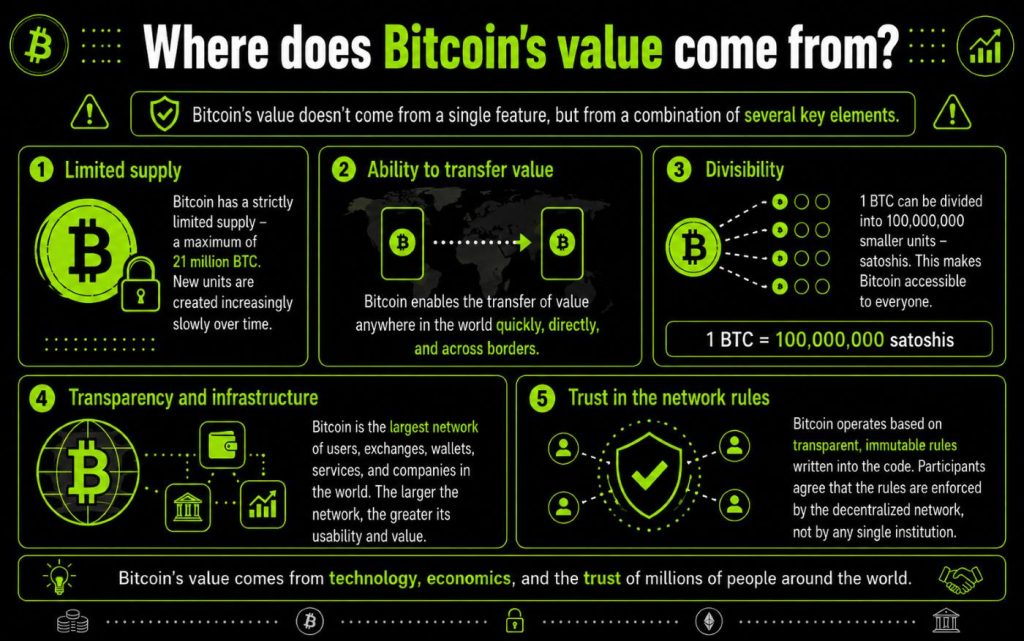
Limited supply
Network participants can review the rules for issuing new units well in advance. The maximum supply does not depend on a current decision by a single company or institution.
Ability to transfer value
BTC can be transferred directly between addresses. The network operates independently of bank opening hours, although access to a particular wallet, exchange or Bitcoin ATM may be limited.
Divisibility
One BTC can be divided into 100 million satoshis. This makes it possible to send both large and very small amounts.
Recognition and infrastructure
An ecosystem of wallets, exchanges, payment systems, financial services and Bitcoin ATMs has developed around Bitcoin. As the number of users and available services grows, BTC can become easier to use.
Trust in the network rules
Some users attribute value to Bitcoin because its supply and the way transactions are validated are determined by publicly available rules, rather than by the decision of a single issuer.
However, market value is not guaranteed. The price may fluctuate rapidly due to demand, economic conditions, regulations, market liquidity, political events, and investor sentiment.
What can Bitcoin be used for?
Bitcoin can serve various purposes depending on the user's needs.
Transferring funds
BTC can be sent directly to another user's address. The recipient may be in the same country or in another part of the world.
Payments
Bitcoin can be used to pay for goods and services if the merchant agrees to accept it. Not every shop or service provider accepts BTC.
Self-custody
Users can store BTC in their own wallets and control the information needed to authorize transactions. This also means they are responsible for protecting their keys.
Investment and speculation
Some people also buy Bitcoin in the hope that its price will rise. This involves a high level of risk because the price can rise or fall sharply.
Converting to cash
At supported Bitcoin ATMs, you can buy BTC with banknotes or sell cryptocurrency and receive cash. Separate guides explain these processes step by step:
Is Bitcoin anonymous?
Bitcoin does not provide complete anonymity. It is a pseudonymous system.
A Bitcoin address does not have to contain a person's name or home address. However, transactions are recorded in a public transaction history. Among other things, you can check:
- addresses involved in the transfer
- the amount transferred
- time of the transaction
- previous activity associated with a given address
- number of confirmations
If an address is linked to a specific person, it becomes possible to analyze the transactions associated with it. Such a link may occur, for example, when using a service that requires customer identification or after publicly sharing one’s own address.
For this reason, Bitcoin should not be treated as a system that guarantees completely anonymous payments.
Is Bitcoin safe?
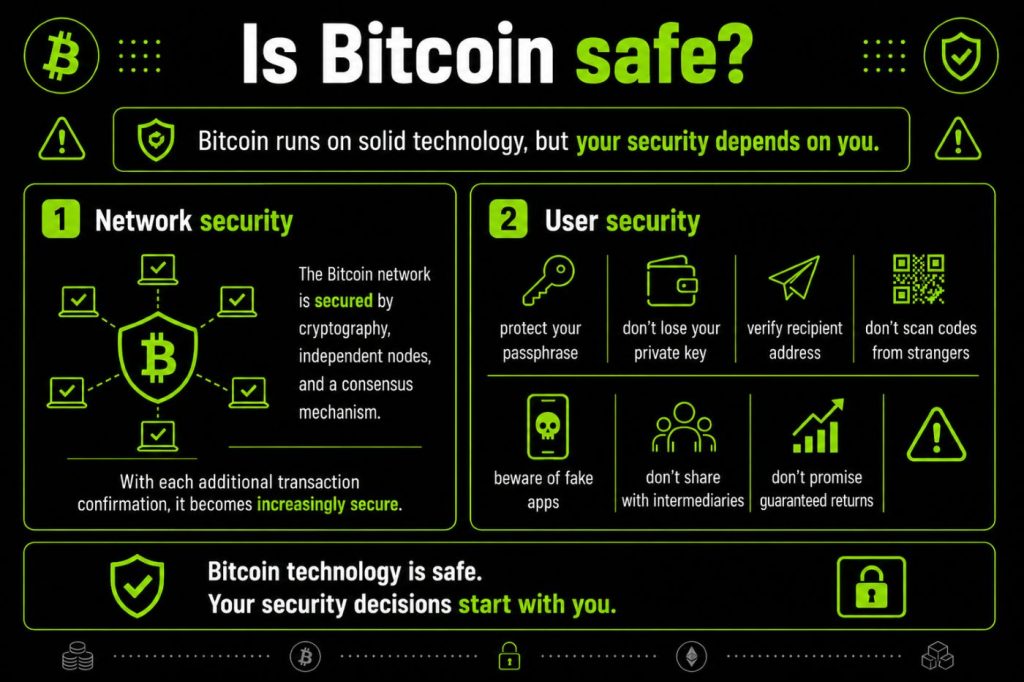
Bitcoin security should be considered at two levels.
Network security
The network uses cryptography, independent verification and a consensus mechanism. Any node can verify whether transactions comply with the rules.
Changing a well-confirmed transaction would require redoing a significant amount of work and competing with the rest of the network. With each additional confirmation, the likelihood of successfully altering an earlier record decreases.
However, this does not mean that every Bitcoin-related website, app, or company is automatically safe.
User security
The most common risks relate to how BTC is used. Funds can be lost, for example, by:
- revealing your recovery phrase
- loss of a private key
- sending BTC to the wrong address
- scanning a QR code belonging to a scammer
- using a fake app
- leaving funds with an unreliable third party
- making a decision based on the promise of a guaranteed profit
A confirmed Bitcoin transaction cannot be reversed by a bank or card issuer. A refund is usually only possible if the recipient voluntarily returns the funds.
FINMA also highlights the risks of third-party cryptocurrency custody. Relevant factors include technical safeguards, how client assets are segregated and the rules that apply if the service provider becomes insolvent. Cryptocurrencies also remain highly volatile assets, and substantial losses are possible.
Is Bitcoin legal in Switzerland?
In Switzerland, Bitcoin can legally be owned, bought and sold. Transactions involving BTC are still subject to applicable law.
However, Bitcoin is not legal tender in Switzerland. The Swiss franc remains the country's official currency, so merchants are not generally required to accept BTC.
Bitcoin can be used for payment if both parties agree to this method. As with any other contract, the agreed terms of the transaction apply.
Companies providing certain cryptocurrency-related services may be subject to rules on anti-money laundering, customer identification, financial services and asset custody. However, simply operating in Switzerland does not mean that every provider is supervised in the same way.
How is Bitcoin taxed in Switzerland?
The Swiss Federal Tax Administration treats payment cryptocurrencies such as Bitcoin as transferable, intangible assets with a determinable value.
As a general rule, individuals should report their BTC holdings on their tax returns. The value is taken into account for cantonal wealth tax purposes based on the market value at the end of the tax period. If no official valuation rate is available, the purchase price converted into Swiss francs may be used.
Simply holding BTC does not generally give rise to taxable income. Gains from the sale of personal property are generally treated as personal capital gains and may be exempt from income tax. Corresponding losses are generally not deductible.
The situation may be different for someone engaged in professional trading or running a business. In that case, profits may be treated as earned income.
The exact tax treatment depends on how BTC is used, the scale of the activity, and cantonal regulations. For larger amounts or frequent transactions, it is advisable to consult a tax advisor.
What should you know before using Bitcoin for the first time?
Before receiving or sending BTC, keep a few basic rules in mind:
- Understand who controls the funds.
Check whether you hold the keys yourself or whether they are held by a third-party company. - Never share your recovery phrase.
You do not need it to receive BTC or complete standard verification. - Check the address before sending.
Compare at least the beginning and end of the address shown in your wallet. - Do not use a QR code sent by someone you do not know.
It could point directly to a scammer's wallet. - Use a small amount for your first transaction.
This lets you check that your wallet works correctly and that the address is correct. - Do not treat past price increases as a guarantee.
Bitcoin remains a highly volatile asset and can lose a significant part of its value.
A detailed comparison of storage methods is available in the article on cryptocurrency wallets.
Key advantages of Bitcoin
The features that attract Bitcoin users include:
- the absence of a single central operator
- predictable issuance rules
- limited total supply
- the ability to transfer value directly
- dividing 1 BTC into 100 million satoshis
- public verifiability of transactions
- the network operates independently of bank opening hours
- the ability to control your own funds
Not all of these features will be an advantage for every user. Controlling your own funds also means taking greater responsibility for protecting the information needed to authorize transactions.
Key risks of Bitcoin
Bitcoin also has important limitations:
- the price of BTC can change sharply
- losing a key can mean permanently losing access
- a confirmed transaction usually cannot be canceled
- funds sent to the wrong address may be impossible to recover
- fake platforms and advisers use Bitcoin in scams
- a third-party service provider may be hacked or become insolvent
- using BTC can create tax and reporting obligations
- Not every merchant accepts Bitcoin as payment
Bitcoin can reduce reliance on a central intermediary, but it does not eliminate risk. Some of the responsibility handled by a bank in a traditional system falls directly on the user.
Summary
Bitcoin is a decentralized network for transferring digital value without a single central operator. The unit used on the network is BTC, which can be divided into smaller units called satoshis.
The validity of transactions is verified by independent nodes, and the transaction history is recorded in a shared ledger. The current rules limit the maximum supply to approximately 21 million BTC.
Bitcoin's value is derived from market demand, limited supply, the network's utility, and the trust of its users. However, it is not guaranteed by any government, bank, or issuer. The price may be subject to significant fluctuations.
In Switzerland, it is legal to own and use Bitcoin, but BTC is not legal tender. Bitcoin holdings must also be declared in accordance with the applicable tax rules.
Before making your first transaction, it is worth understanding how control over funds works, setting up the right wallet and learning the basic security rules. Only then should you decide how to buy, sell or store BTC.
Frequently Asked Questions
Bitcoin is a decentralized digital payment network with a unit of value known as BTC. It allows users to transfer value directly to one another without a single central operator.
Bitcoin refers to the network and protocol. BTC is the symbol for the unit transferred on that network. In everyday use, the two terms are often used interchangeably.
No. Bitcoin is one cryptocurrency. Other projects, such as Ethereum, stablecoins and other digital assets, may have different rules, uses and issuance methods.
Bitcoin is not controlled by any single company, individual, or institution. The rules are verified by independent nodes, and users decide for themselves which software to use.
No. One BTC can be divided into 100 million satoshis, so you can own or transfer only a small fraction of a Bitcoin.
Bitcoin is not backed by physical gold or a central bank guarantee. Its price depends on demand, supply, the network's utility, market liquidity, and participant confidence.
The source code can be copied and used to create another network. However, a copy does not automatically become Bitcoin because it does not share the same transaction history, participants or level of acceptance. The network's rules also prevent the same BTC from being spent twice.
Not entirely. Addresses do not have to contain personal information, but the transaction history is public. Bitcoin is therefore referred to as a pseudonymous system.
A confirmed transaction usually cannot be canceled by a bank or payment provider. A refund generally requires the recipient to send the funds back in a new transaction.
Yes. Bitcoin can legally be owned, bought, sold and used if both parties agree to this form of payment. However, BTC is not legal tender in Switzerland.
Generally, yes. BTC holdings must be declared as assets in accordance with the rules that apply in the relevant canton. Private capital gains are generally exempt from income tax, but professional trading may be treated differently.
No investment is risk-free. Bitcoin is highly volatile and its value can fall significantly. You may lose some or all of the money you invest.